Event
Riter VANN
Elin Eriksen is a professional artist, portrait painter and illustrator who has her studio in Nesodden. She has five years of education in art from Norway, England and Japan. She has exhibited in Japan, Brazil, Norway and England. Lived in London for 14 years until 2012.
Plant Portrait, in this series the relationship to plants comes through more clearly than before. Through realistic and more abstracted paintings she seeks to capture the essence, the soul of the plant, inspired by Hilma af Klint and Georgia O’Keeffe. Like the painting “Lilacs” which came to her as she stood for a long time with her eyes closed, smelling lilacs. A large painting of St. John’s Wort (Prikkperikum) is used to treat SAD, and the artist keeps it on the wall of her own studio through the winter to give a sense of sunlight. Eriksen loves to smell the wormwood plant outside her studio, the strong scent brings me back to “here and now”. “Late Summer Blend” is an art and outreach project where she made a tea blend created to make a tasty and nourishing tea to help the immune system, stomach and digestion, as well as nerves and emotional health. She has made 45 tea bags from plants grown or foraged herself. The bags were hand printed with linocut of a wild rose. Students at a German university in leadership and sustainability, from all over the world, received this gift after a stay outside Oslo, and she shared her own experiences of working with herbs, plants, birds and how she connects with different aspects of nature. The large paintings of Yarrow and Mugwort, both important in magic, were shown at økouka in 2024. Eriksen recently took part in a panel talk where she shared her journey with plants and has collaborated with the Norwegian Mushroom and Useful Plants Society.
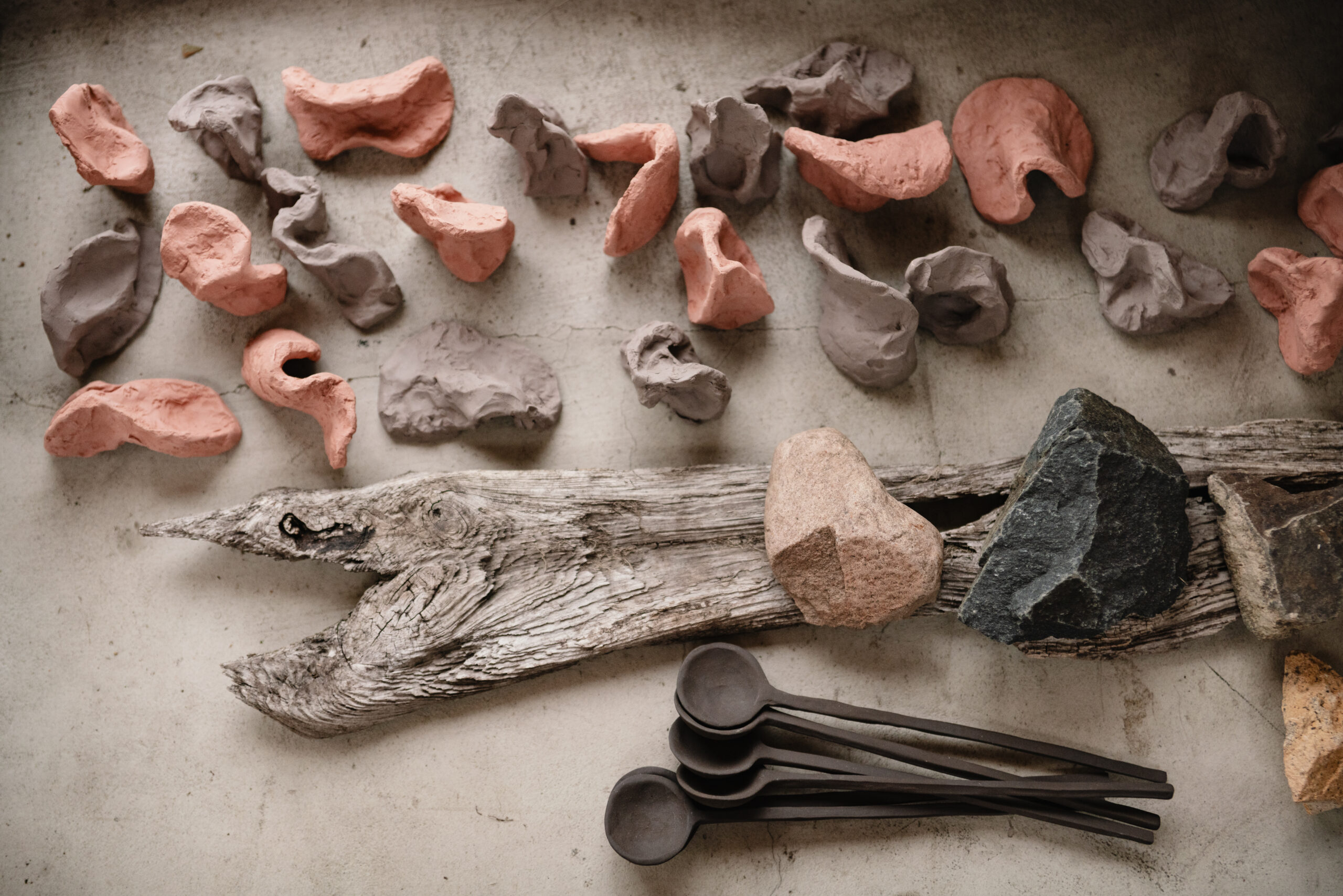
Hélène Arja’s artistic practice is centered on ceramics as a medium for conveying cultural rituals, sense of place and material exploration. In 2026 she will work towards an agreed solo exhibition at the Norwegian Sculptors’ Association (NBF) in Oslo, and begin a traveling art project in local areas in Norway, with further artist collaborations in 2027.
Her artistic practice explores clay’s potential as a relational material, to create belonging between people, nature and place. She works at the intersection of craft and place development. Arja has 20 years of experience with ceramics, and creates sensory artworks where tactile and ritual qualities are entirely central. She also holds a master’s degree in design from AHO, studies in sociology, and has 14 years of experience with nature oriented place development, working as an advisor for several of Europe’s largest real estate companies. A red thread through her artistic practice is creating works and spatial installations that foster presence, community, curiosity and strengthen people’s sense of belonging to nature. She works from the approach that “we humans are nature, not something separate from it, and this premise must therefore guide our place development if we are to achieve a sustainable future.”
Tone Bjordam (b. 1975) has a studio in Nordmarka in Oslo. For many years she has collaborated with researchers, especially within ecology, geology, biology and society and climate related research. She has shown art in, among other places, the Nordic countries, the Faroe Islands, Portugal, Germany, the Netherlands, Singapore, Uruguay, the USA and Canada. She has recently had a solo exhibition at Glasslåven, Hadeland (2025), a solo exhibition at Bomuldsfabriken Kunsthall in Arendal (2024), and performed at the Louisiana Museum of Modern Art in Denmark (2023).
Processes of change in nature are a recurring theme throughout Bjordam’s artistic practice. She explores nature’s influence on humans, through both abstract and naturalistic visual language. For over 20 years she has worked with filming and photographing movement and unfolding in flowing ink and paint. At a meditative pace the viewer is presented with cascades of colors and pigments unfolding in water. The work stems from a search for meditative and reflective states, the kind that often arise when encountering clouds, light phenomena, mountain formations, the sea or details in the forest. The video Seasonal Transitions (2021) is inspired by the seasons’ gradual transitions from one state to another, with sounds of ice, stone, falling snow crystals, water and river rush, lynx cries and birdsong. In the photography project Morf, transformations in lowland landscape (2021), we see a teeming biological diversity in the miniature landscape of old stumps and upturned roots in the forest.
Bjordam has a longstanding collaboration with dancer Anna Asplind, https://www.annaasplind.se/performer/. They explore how physically mirroring movements and shapes in nature can bring us closer to understanding and connection with the landscapes we surround ourselves with. Bjordam believes there is enormous potential in art to bridge our understanding of the world and the feelings needed for good processes of change to take place.
Cecilie Dawes (b. 1982) founder of Food Studio. She has worked internationally and across disciplines to create experiences centered on sensory experiences with food and nature at their core. For example get away merri creek as part of the Melbourne Food and Wine Festival, get away Awaji Island in collaboration with Graf and Masayo Funakoshi, curated the food experience for Soil Procession Losæter, The Last Supper Losæter, The Final Feast for Oslo’s year as European Green Capital.
She was part of the “new Nordic” movement in the Nordic food scene. In 2025 the National Museum highlighted this movement’s work: “Taking local landscapes as its starting point, the movement created a distinctive aesthetic that showed up in dishes, tableware and restaurant interiors. Natural materials such as stone, moss and untreated wood, as well as handmade ceramics, muted natural colors and wild plants as decoration, were often used elements. The exhibition shows how the food movement developed in parallel with a growing interest in ecology, nature and sense of place in society.” The exhibition later traveled to the National Nordic Museum in Seattle.
Photo: Monica Løvdahl